How Gas Rationing Created America's Drive-Thru Culture
The Problem Nobody Saw Coming
Picture this: It's 1943, and you're craving a burger in Los Angeles. But there's a catch—your car tires are made of precious rubber needed for the war effort, and every gallon of gas is rationed. Walking seems like the sensible choice, but what if there was another way?
This exact scenario played out across America during World War II, creating an unexpected problem for restaurants and customers alike. Nobody could have predicted that these wartime restrictions would accidentally birth one of America's most enduring cultural institutions: the drive-thru.
When Parking Became a Luxury
Before the war, American dining was straightforward. You parked, you walked in, you ate, you left. But by 1942, the Office of Price Administration had implemented strict rationing programs. Rubber for tires became so scarce that the government launched "scrap drives," asking Americans to donate old tires, boots, and even bathing caps to the war effort.
Gas rationing hit even harder. Families received color-coded stickers for their windshields—most got "A" stickers, allowing just three to four gallons per week. Restaurant owners watched their parking lots empty as customers chose to walk to closer establishments or simply stay home.
Harry Snyder, who ran a small burger stand in Baldwin Park, California, faced this reality daily. His customers loved his fresh burgers, but fewer could afford the gas to visit regularly. Traditional carhop service—where waitresses delivered food to parked cars—still required customers to find parking spaces and idle their engines. In a world where every drop of gasoline mattered, this seemed wasteful.
The Accidental Innovation
Sometime in late 1948, just as rationing restrictions were lifting, Snyder made a decision that would change American dining forever. Instead of expanding his parking lot or hiring more carhops, he cut a hole in the wall of his burger stand and installed what he called a "two-way speaker box."
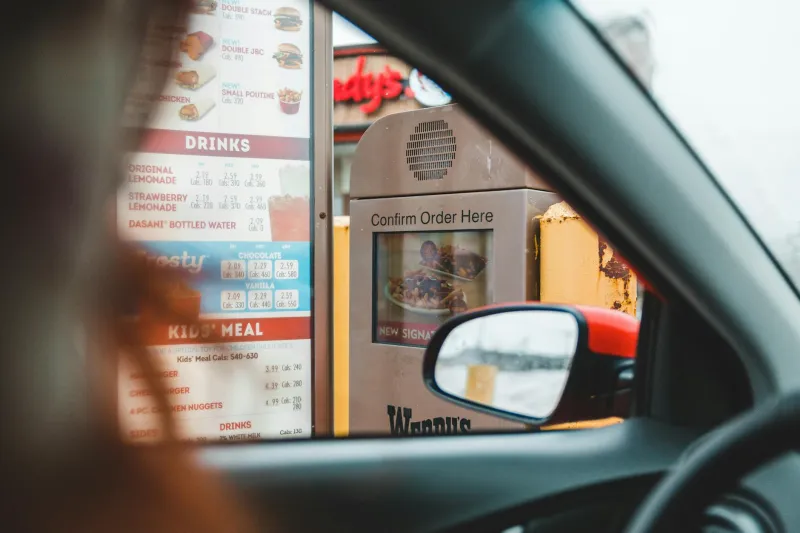
The concept was brilliantly simple: customers could drive up, place their order through the speaker, pay at the window, and drive away—all without turning off their engines or hunting for parking spaces. Snyder called it "drive-thru" service, and it solved multiple wartime-era problems at once.
Customers saved gas by avoiding the parking dance. They saved time by skipping the walk to and from their cars. Most importantly, they could grab a meal without the social interaction that many Americans, still adjusting to post-war life, sometimes preferred to avoid.
The Perfect Storm of Circumstances
What made Snyder's innovation so successful wasn't just the convenience—it was the timing. America was entering an unprecedented era of car culture. Returning veterans were buying homes in new suburban developments, often miles from city centers. The Federal-Aid Highway Act was creating new roads that connected these suburbs to urban areas. Car ownership was becoming not just desirable, but necessary.
At the same time, Americans were developing new relationships with speed and efficiency. The same wartime manufacturing techniques that had produced tanks and planes were now being applied to civilian goods. Fast, standardized, and efficient became the new American way.
Snyder's drive-thru perfectly captured this zeitgeist. It was fast, efficient, and car-centric. Within a few years, his small burger stand had grown into In-N-Out Burger, and competitors across the country were installing their own speaker boxes and drive-thru windows.
From Necessity to National Obsession
By the 1950s, drive-thrus were spreading beyond California. McDonald's introduced drive-thru service in 1975, and the concept exploded nationwide. What began as a wartime workaround had become a fundamental part of American dining culture.
Today, drive-thru sales account for nearly 70% of all fast-food revenue in the United States. Americans spend billions of dollars annually without ever leaving their cars, ordering everything from coffee to prescription medications through drive-thru windows.
The COVID-19 pandemic only reinforced the drive-thru's importance. When dining rooms closed, drive-thrus kept restaurants alive. When social distancing became essential, the contactless service that Harry Snyder invented out of wartime necessity suddenly seemed prescient.
The Unintended Legacy
Looking back, it's remarkable how a simple response to gas rationing created such a lasting cultural shift. Snyder wasn't trying to revolutionize American dining—he was just trying to keep his customers happy during difficult times. But his pragmatic solution to a temporary problem ended up defining how generations of Americans would eat.
The next time you roll up to a drive-thru window, remember that you're participating in a tradition born from wartime sacrifice and one entrepreneur's refusal to let rationing kill his business. Sometimes the most enduring innovations come not from grand visions of the future, but from simple solutions to immediate problems.
In Harry Snyder's case, a hole in the wall became a window into America's automotive future—one burger at a time.