Nobody Knows Why We Say It, But Try Staying Silent Next Time Someone Sneezes
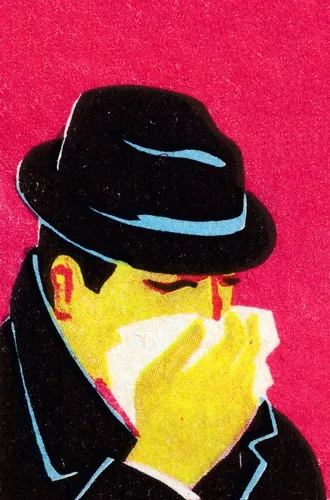
Photo: Unknown (commercial matchbox manufacturer), Public domain, via Wikimedia Commons
Somewhere in your life, probably before you were old enough to question it, someone trained you to say two words every time a person nearby expelled air through their nose. You didn't sign anything. Nobody handed you a rulebook. And yet here you are, decades later, reflexively blessing strangers in coffee shops, coworkers in conference rooms, and people you've never met in grocery store aisles.
The phrase is so automatic that not saying it feels like a small social crime. People notice. They give you a look. And the sneezer — left unblessed — sits in a moment of weird, unacknowledged silence.
So where did this come from? And why, in a country that's largely moved on from the beliefs that created this ritual, does it show absolutely no signs of going away?
The Pope Made It Official (Sort Of)
One of the oldest documented explanations traces back to 590 AD, when bubonic plague was carving through Europe with terrifying efficiency. Pope Gregory I — Gregory the Great — allegedly ordered his followers to respond to a sneeze with a blessing, because sneezing was understood at the time as an early symptom of infection. Saying "God bless you" was, in that context, less a pleasantry and more a desperate prayer for someone who might already be dying.
It's a compelling story. It also might be at least partially invented — historians have struggled to pin down a definitive papal decree, and the timeline doesn't quite hold up under scrutiny. But the plague connection isn't entirely fictional. Medieval communities genuinely did associate sneezing with illness and spiritual vulnerability, and blessing someone was considered a form of protective intervention. Whether Gregory formally commanded it or not, the behavior fits neatly into the logic of the era.
The Soul Was Trying to Escape
Long before the plague, though, there was a stranger theory — and it shows up across multiple ancient cultures with enough consistency to suggest it wasn't just one civilization's quirk.
The belief, in various forms, held that a sneeze created a moment of physical vulnerability so intense that the soul might slip out of the body. Some versions suggested that evil spirits could take advantage of that gap and enter. Others believed the heart briefly stopped. In ancient Rome, the phrase absit omen — "may the omen be absent" — was used as a response to sneezes, treating them as potentially bad omens that needed to be verbally neutralized.
Aristotle wrote about sneezing as a sign of divine activity. The ancient Greeks considered a sneeze on the right side of the face to be lucky. In some early cultures, covering the mouth during a sneeze was about keeping the soul in, not about containing germs — germ theory being about 2,400 years away at that point.
The result was a patchwork of superstitions, all pointing toward the same conclusion: when someone sneezes, something is happening that requires a verbal response.
How It Crossed the Atlantic and Stuck
European settlers brought the habit to America, where it blended into the already-superstition-friendly culture of early colonial life. By the 18th and 19th centuries, "God bless you" or simply "bless you" was standard practice across most of the country, embedded in the kind of everyday manners that parents passed to children without explanation.
The interesting thing is what happened next: nothing. Germ theory arrived. Louis Pasteur changed how we understood disease. The soul-escaping explanation became, charitably, a historical footnote. The plague receded into the past. And yet the phrase didn't go anywhere. It just quietly detached from its original meaning and kept operating as a social reflex.
By the 20th century, "bless you" had become less about theology and more about acknowledgment. Saying it was a way of recognizing that something had happened — that a person near you had experienced an involuntary physical event — and that you had noticed. The religious content drained away for many Americans, leaving behind a ritual that now functions more like "excuse me" than an actual invocation of divine protection.
The Social Pressure That Keeps It Alive
Here's what makes this particular tradition so durable: the cost of not doing it is higher than the cost of doing it.
Say "bless you" and nothing happens. You've fulfilled an expectation, the moment passes, everyone moves on. Stay silent and you've created a tiny, uncomfortable social rupture. The sneezer may feel ignored. People nearby may register the omission. You'll probably feel mildly awkward for no logical reason.
This is how social rituals maintain themselves long after the original logic disappears. They stop being about belief and start being about belonging. Saying "bless you" signals that you're a considerate person who follows the unwritten rules of polite interaction. Not saying it signals... something else. Rudeness, maybe. Distraction. Indifference.
Some Americans have tried to push back. Secular communities have occasionally advocated for replacing "bless you" with something more neutral — "gesundheit" (German for "health") has been a popular alternative, though it comes with its own historical baggage. A small number of schools and workplaces have even attempted to discourage the phrase altogether, usually to significant public backlash.
Those efforts have gone essentially nowhere. "Bless you" remains the dominant response, practiced by religious and non-religious Americans alike, in red states and blue states, across every demographic you can name.
The Phrase That Outlived Its Reason
What "bless you" really tells us is something interesting about how cultural habits work. They don't require their original justification to survive. They just need to become load-bearing parts of everyday social interaction — small signals that help people feel seen and acknowledged.
The plague is gone. The soul-escape theory is gone. The theological urgency is largely gone. What remains is a two-word phrase that functions as a tiny, automatic gesture of human recognition. You sneezed. I noticed. I acknowledged you. We're fine.
It's a remarkably efficient social tool for something that started as a medieval response to mortal terror.
So the next time someone sneezes near you, go ahead and say it. Not because the soul is escaping. Not because the plague is coming. But because several thousand years of accumulated social expectation have made silence the stranger choice — and honestly, at this point, it's just easier.