How a Ruined Lab Experiment Turned Blue Into the Color of Power
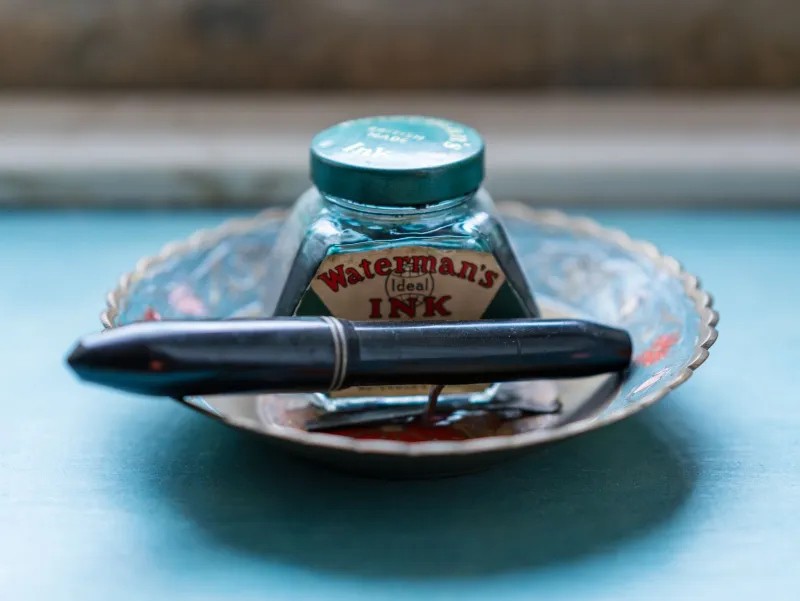
Think about the last time you signed something important. A lease. A permission slip. A check. Chances are, you reached for a blue pen without thinking twice. It just felt right — official, serious, real. But that instinct didn't come from nowhere. It came from a chemistry lab in Germany, a failed experiment, and a cascade of accidents that nobody planned and everybody benefited from.
The Chemist Who Made a Mess
In 1876, a young German chemist named Heinrich Caro was working at BASF — then a scrappy dye company trying to compete in the booming synthetic color market — when he began collaborating with a researcher named Carl Gräbe on a series of experiments involving coal tar derivatives. Two years later, in 1878, another BASF chemist named Heinrich August Bernthsen was attempting to synthesize a red dye when something went sideways in his reaction. Instead of the warm crimson he was chasing, the solution turned a vivid, almost electric blue.
The compound was methylene blue. Bernthsen had no idea what he'd made. He certainly didn't know he'd just handed the modern world one of its most consequential colors.
At first, the scientific community was more interested in the dye's medical applications than its aesthetic ones. A German physician named Paul Ehrlich quickly noticed that methylene blue had a strange talent: it stained biological tissue in ways that made individual cells visible under a microscope. Before long, it was being used to identify malaria parasites in blood samples — a genuine medical breakthrough. For a moment, it looked like this accidental blue would be remembered as a tool of science, not a pigment for your desk drawer.
When Blue Stopped Being Expensive
Here's the thing about blue that most people don't realize: for most of human history, it was absurdly hard to make.
The ancient Egyptians had to grind lapis lazuli imported from Afghanistan. Medieval European painters paid more for ultramarine blue than they paid for gold. Royalty wore blue specifically because only royalty could afford it. For centuries, the color carried an almost mythological weight — it was rare, expensive, and deliberately exclusive.
Methylene blue demolished all of that. Because it was synthesized from coal tar — a cheap industrial byproduct — it could be produced in massive quantities at a fraction of the cost of natural pigments. By the 1880s and 1890s, the price of blue had collapsed. Textile manufacturers started dyeing fabric with it. Artists started using it. And then, crucially, ink manufacturers started noticing.
Fountain pens were becoming the writing instrument of the era, and they needed ink that flowed smoothly, dried quickly, and didn't corrode the pen's metal components. Early iron gall inks — the dark, brownish-black standard for centuries — were corrosive and temperamental. Methylene blue offered a cleaner, more reliable alternative. By the early twentieth century, blue ink had become the dominant choice for fountain pens across Europe and America.
The Bureaucracy Connection
This is where things get interesting for Americans specifically.
As blue ink spread through the pen market, it coincided almost perfectly with an explosion in American paperwork. The late 1800s and early 1900s brought the rise of the modern corporation, expanded federal government, public schooling systems, and mass literacy. People were writing more than ever before — contracts, letters, ledgers, forms. And they were writing in blue.
One practical quirk cemented blue's dominance in legal and official contexts: when documents were photocopied using early reproduction technology, black ink sometimes blended invisibly into the background. Blue ink, by contrast, reproduced with a faint but distinct difference that made it easier to identify an original document from a copy. Banks and courts began quietly preferring — and eventually requiring — blue or black ink on official paperwork. Blue had gone from accident to convention to law.
Schools reinforced the habit from childhood. Blue pens were cheap, universally available, and socially legible as the "correct" choice. By the mid-twentieth century, the association between blue ink and seriousness, authority, and legitimacy had become so deeply embedded that questioning it felt almost subversive.
The Color That Outlived Its Inventor
Bernthsen, the chemist who accidentally created methylene blue, went on to have a distinguished career at BASF and contributed meaningfully to organic chemistry. But he probably didn't spend much time thinking about ink. His discovery was a scientific curiosity that became a medical tool that became a commercial dye that became a cultural institution — each transformation happening without any single person steering the ship.
Today, methylene blue is still used in medicine. It treats a blood disorder called methemoglobinemia, and researchers have explored its potential in treating Alzheimer's disease. It stains lab slides in biology classrooms across the country. And of course, it's still in your pen.
The next time you uncap a blue ballpoint to sign your name on something that matters, you're participating in a 140-year chain of accidents. A failed dye experiment, a collapsing pigment market, a fountain pen boom, and a mountain of American bureaucracy — all of it conspiring to make blue feel like the only logical choice.
It wasn't logical. It was lucky. But at some point, the two start to look the same.