The Keyboard Layout That Was Built to Fail — And Won Anyway
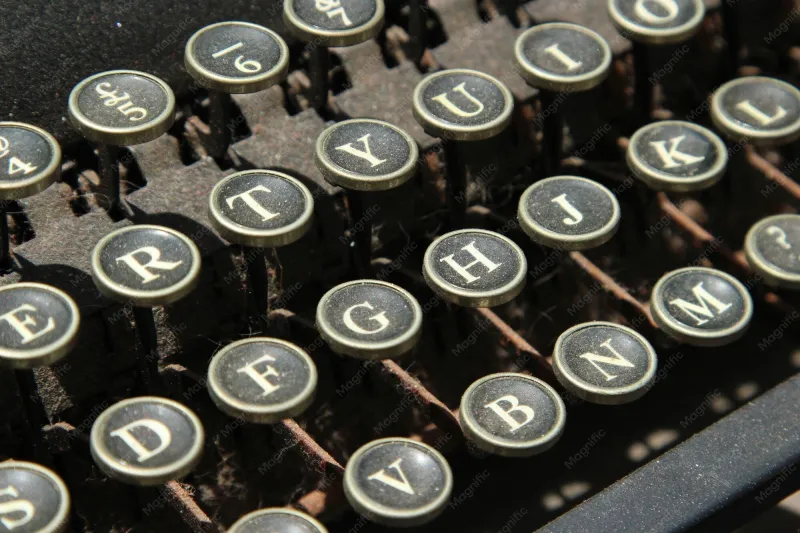
Photo: vintage 1870s typewriter keys close up mechanical, via img.freepik.com
Look at your keyboard. The letters aren't in alphabetical order, they're not arranged by frequency of use, and they're not laid out for speed. They're laid out the way they are because of a mechanical problem that was solved over 150 years ago — a problem that no keyboard has faced since the 1970s.
You are typing on a solution to a problem that no longer exists. And the odds of that changing in your lifetime are vanishingly small.
The Jamming Problem Nobody Talks About Anymore
In 1868, Christopher Latham Sholes was building one of the first commercially viable typewriters in Milwaukee. The machine worked on a simple principle: press a key, a metal arm swings up and strikes an inked ribbon against paper. Simple enough — except when you typed quickly, the arms jammed together. Two keys hit at nearly the same time, the arms collided mid-swing, and the whole mechanism locked up.
Sholes's solution was counterintuitive but logical: if he could slow typists down just enough to prevent two arms from colliding, the machine would work reliably. The way to do that was to separate commonly paired letters — put them far apart on the keyboard so fingers had to travel greater distances between frequent combinations. The more time fingers spent moving, the less likely two arms were to clash.
The layout that resulted from this mechanical triage was QWERTY. It placed common letter pairings — TH, HE, IN, ER — far apart from each other. It put vowels and consonants in arrangements that maximized finger travel. It was, by design, not the fastest possible layout for human hands. It was the fastest possible layout for a machine that kept breaking.
In 1873, Sholes licensed the design to Remington, the gun manufacturer that had pivoted to typewriters after the Civil War ended the weapons boom. Remington refined it slightly, mass-produced the machines, and sold them across the country. QWERTY shipped with every unit.
The World Tried to Fix It
By the early 20th century, typewriters were everywhere — offices, newsrooms, government agencies, courtrooms. And as typing became a professional skill, people started studying it seriously. That's when researchers noticed something uncomfortable: QWERTY wasn't great for human hands.
The most famous challenge came from August Dvorak, a University of Washington professor who spent years in the 1930s analyzing which letters appeared most frequently in English, how often they appeared in sequence, and which fingers were strongest and most agile. In 1936, he patented a new layout — the Dvorak Simplified Keyboard — that put the most common letters on the home row, balanced workload between hands, and reduced finger movement by a significant margin.
Studies suggested Dvorak typists could be trained faster and made fewer errors. The U.S. Navy ran a wartime efficiency study in 1944 that reportedly found retraining typists on Dvorak paid for itself within ten days of increased productivity. The case for switching seemed overwhelming.
And then nothing happened.
Why Logic Lost
The problem wasn't the keyboard. The problem was everything around the keyboard.
By the time Dvorak published his layout, QWERTY had been the standard for sixty years. Typing schools taught it. Typing tests measured it. Every office in America had QWERTY typewriters. Every trained typist knew QWERTY. Switching to a new layout didn't just mean buying new machines — it meant retraining hundreds of thousands of workers, rebuilding the entire infrastructure of professional typing education, and accepting a productivity crash during the transition period while everyone relearned from scratch.
The economic inertia was simply too large. No individual company could justify the cost of switching when all their employees, all their suppliers, and all their potential hires were trained on the existing standard. And no typing school would teach Dvorak when no employers were asking for it. The system locked itself in place.
When electric typewriters arrived, they kept QWERTY. When personal computers arrived in the 1970s and 80s — a genuine opportunity to reset the standard — manufacturers kept QWERTY because users already knew it. Every new platform deferred to what came before.
The Digital Non-Revolution
The cruelest part of the QWERTY story is the smartphone era. When touchscreen keyboards arrived, there was a real moment of possibility. Software keyboards had no mechanical parts. There were no metal arms to jam. The entire original justification for QWERTY was irrelevant. Designers could have shipped any layout they wanted.
Apple and Google shipped QWERTY.
They did it because users expected it. Because app developers were building for it. Because muscle memory — accumulated across millions of existing users — was more powerful than any efficiency argument. Alternative keyboard apps exist for both iOS and Android. Almost nobody uses them.
Dvorak is still available as a system option on Windows, macOS, and Linux. It has been for decades. Usage estimates suggest it accounts for somewhere between one and two percent of typists.
What QWERTY Actually Proves
The story of the QWERTY keyboard is usually told as a lesson in bad design winning through historical accident. That's true, but it misses the more interesting point.
QWERTY reveals how standards actually work. Once something reaches a critical mass of adoption — once enough people, machines, and institutions are organized around a single system — switching costs become so enormous that logic stops mattering. The question stops being "what works best?" and becomes "what does everyone already know?"
The machine that made QWERTY necessary stopped being manufactured decades ago. The problem it solved is ancient history. But the solution is on every laptop, every phone, and every tablet sold in America today — and it will almost certainly be on whatever you're typing on ten years from now.
The most durable technologies aren't always the best ones. They're the ones that arrived first and made themselves impossible to leave.