Why You Keep Pressing a Button That Does Absolutely Nothing
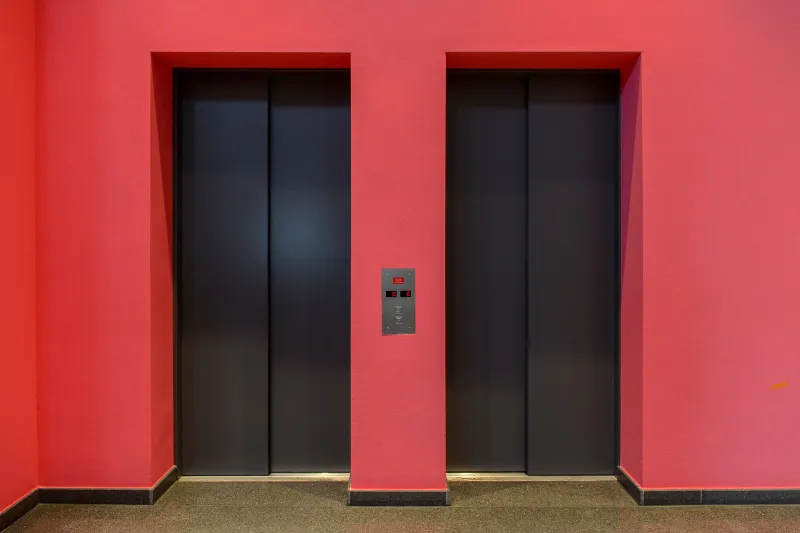
You know the move. You step into an elevator, the doors stay open, someone across the lobby makes eye contact and starts walking toward you, and your thumb finds that 'door close' button with the practiced confidence of someone who has done this a thousand times.
The doors close. You feel a small, private satisfaction.
Here's what actually happened: nothing. You pressed a button. The elevator ignored you completely. The doors closed on their own timer, the same way they would have whether you were standing there or staring at your phone.
And the people who built the elevator knew that the whole time.
A Button With a History
Elevators weren't always this way. In the early days of push-button elevators — roughly the 1950s and 1960s, after the profession of elevator operator began to disappear — the controls inside the cab were genuinely functional. Every button did something. The 'door open' and 'door close' buttons gave passengers real control over the machine, which made sense when elevators were slower, buildings were less automated, and the engineering was simpler.
The shift came gradually, through two separate forces that arrived within a few decades of each other.
The first was the Americans with Disabilities Act of 1990. Among its many provisions, the ADA established minimum door-open times for elevators in public buildings — the doors had to stay open long enough for a person using a wheelchair or walking with difficulty to safely enter or exit. That requirement effectively removed meaningful 'door close' functionality in most public elevators, because the timer couldn't be overridden by a passenger anyway. The doors were going to hold as long as the code required, regardless of what button you pressed.
 Photo: Americans with Disabilities Act, via static.vecteezy.com
The second force was the modernization of elevator control systems. As buildings upgraded to computerized elevator management — systems that coordinate multiple cars, predict traffic patterns, and optimize wait times across an entire building — the individual passenger's ability to directly command the machine became largely irrelevant. The building's brain was already making those decisions. Your button was, at best, a suggestion.
So Why Is It Still There?
This is where the story stops being about engineering and starts being about human psychology.
When building managers and elevator manufacturers realized that removing the 'door close' button would create a visible gap on the control panel — a conspicuous absence that passengers would immediately notice and find unsettling — they faced a quiet design problem. An elevator with a hole where a button used to be feels broken. Passengers complain. Maintenance calls increase. People assume something is wrong with the machine.
The solution, which emerged not from any single decision but from a kind of industry-wide intuition, was to leave the button exactly where it was. Same size, same label, same position. Just not connected to anything.
This is what researchers and designers call a placebo control — an interface element that exists not to perform a function but to give the user a sense of participation. The psychology behind it is well-documented. When people feel they have some control over a situation, even illusory control, they experience less frustration and report higher satisfaction with the outcome.
The elevator arrives at the same time either way. But the person who pressed the button feels better about the wait.
You're Surrounded by Placebo Controls
Once you know about elevator buttons, you start seeing the same principle everywhere.
The 'walk' button at many urban crosswalks? In cities like New York, most of them were deactivated decades ago when traffic management moved to centralized computer timing. The city kept the buttons in place partly for the same reason — removing them would confuse pedestrians and generate complaints. A 2004 investigation by the New York Times found that fewer than 750 of the city's roughly 3,250 pedestrian buttons were still functional.
 Photo: New York, via theplanetd.com
Office thermostats in shared buildings are another classic example. Studies have found that many thermostats in commercial office spaces — particularly in large buildings with centralized HVAC systems — are dummy units. They're installed to give individual employees the feeling of environmental control, while the actual temperature is managed at the building level. Facilities managers have known this for years. The thermostat wars that play out in offices across America are, in many cases, entirely theatrical.
Even some casino slot machines have been designed with extra buttons that don't alter the odds in any way, purely to give players a stronger sense of agency over the outcome.
What This Says About Us
The placebo button phenomenon reveals something genuinely interesting about the relationship Americans have with technology. We are, as a culture, deeply invested in the idea that our inputs matter — that pressing a button, turning a dial, or clicking a setting translates directly into a change in the world around us. When that relationship breaks down, when we're passengers in a system rather than operators of it, the discomfort is real and immediate.
Designers have learned to manage that discomfort not by giving people more actual control, but by maintaining the appearance of control. It's a solution that works remarkably well, which is perhaps a little unsettling when you think about it too hard.
The elevator button is a small example, but the logic scales. Loading bars on websites are often artificially slowed to make software feel like it's working harder. Progress indicators on food delivery apps update in ways that have more to do with user anxiety management than real-time tracking. The feedback loop between human and machine is, more often than you'd expect, partially staged.
Press Away
None of this means you should stop pressing the button. The small ritual of it — the thumb jab, the moment of manufactured urgency — is genuinely harmless, and the mild satisfaction it produces is real, even if the cause isn't.
But the next time you're standing in an elevator watching those doors take their sweet time, consider that the button under your thumb may be one of the more honest pieces of design in the building. It doesn't pretend to do something complicated. It just quietly absorbs your impatience and gives you nothing back except the feeling that you tried.
Sometimes, apparently, that's enough.