The Failed Office Equipment Pitch That Built the American Gym
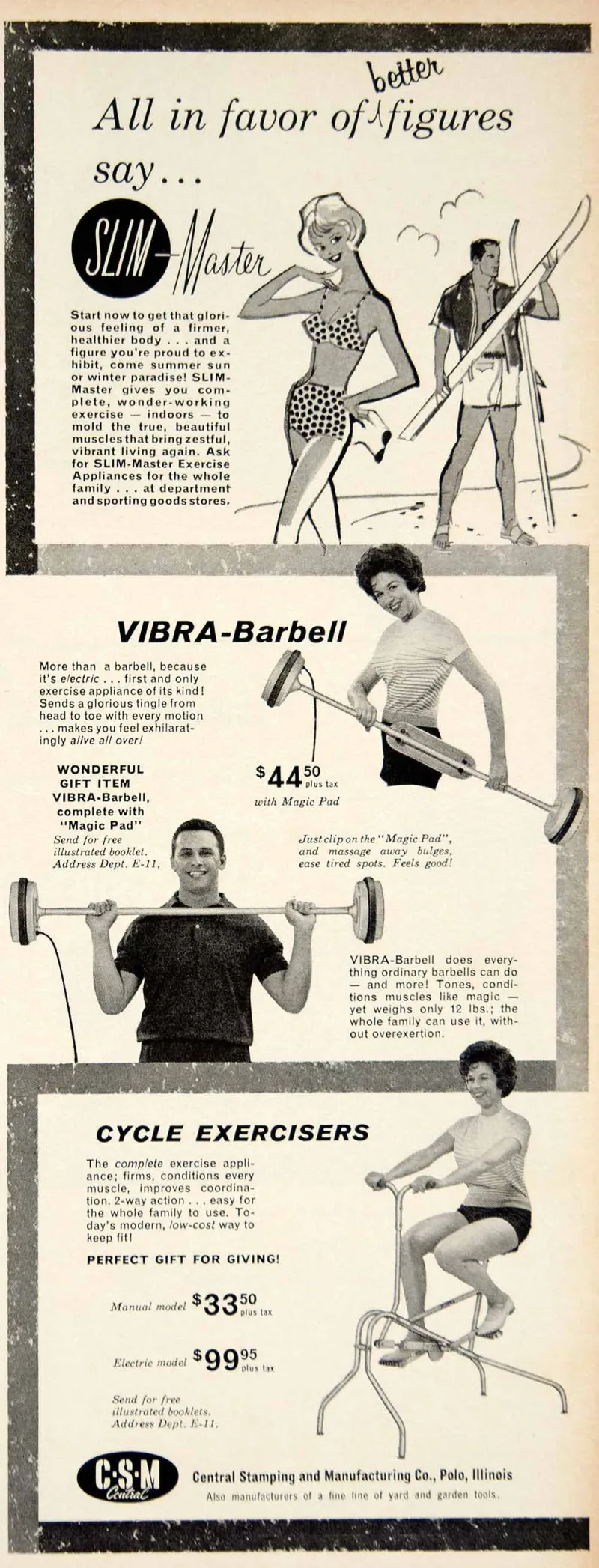
Photo: vintage 1960s gym exercise machines retro fitness, via www.periodpaper.com
There's a particular kind of American business story that starts with one thing and ends up inventing something completely different. The Post-it Note. WD-40. Bubble Wrap. These are the origin myths of accidental commerce, and they share a common thread: someone was solving a problem nobody knew they had.
The commercial gym fits neatly into that tradition. And like most great accidents, it started with a spectacular failure.
Vic Tanny and the Furniture That Wouldn't Sell
Vic Tanny was a bodybuilder from Rochester, New York, who had migrated to California in the 1940s with ambitions that were hard to pin down. He'd opened a small gym in Santa Monica — more of a serious weightlifting space than anything else, frequented by dedicated athletes and the occasional Hollywood actor looking to bulk up for a role. It was niche, intense, and not particularly profitable.
By the late 1950s, Tanny had expanded his gym operation modestly, but he was also dabbling in other ventures. One of them involved selling exercise equipment — specifically, a line of stationary machines designed for office environments. The pitch was aimed at corporations: give your employees a way to exercise without leaving the building, boost productivity, reduce sick days. It was ahead of its time in the worst possible way. Corporate America in 1958 had approximately zero interest in employee wellness. The machines sat in warehouses.
Faced with inventory he couldn't move and an equipment budget already spent, Tanny made a pragmatic decision: put the machines in his gyms.
From Weightlifting Den to Something New
Here's where the story gets interesting. The equipment Tanny had purchased for his failed office pitch was designed for general fitness — not the heavy iron of competitive bodybuilding, but lighter, more accessible machines. When he installed them in his gyms, something unexpected happened: women started coming in.
This was not a small development. Commercial gyms in the 1950s were almost exclusively male spaces. They smelled like liniment and ambition and were decorated primarily with motivational posters of men who looked like they'd been sculpted from concrete. They were intimidating by design.
The new equipment changed the atmosphere. It suggested a different kind of exercise — achievable, structured, not necessarily competitive. Tanny, ever the opportunist, leaned in. He redesigned his spaces. He added carpeting, mirrors, and better lighting. He hired staff who could explain the machines to newcomers. He began advertising to couples and to women specifically, using language about health and appearance rather than strength and competition.
The Vic Tanny gym chain grew rapidly through the late 1950s and into the 1960s, eventually reaching over 80 locations across the country. It was, by most accounts, the first true commercial gym chain in American history.
Selling the Experience, Not Just the Exercise
What Tanny had stumbled onto — and what his successors would spend decades refining — was the idea that people don't just pay for access to equipment. They pay for an environment, a social context, and a version of themselves they're working toward.
This seems obvious now. But in the early 1960s, it was genuinely novel. Exercise had been, for most Americans, either a byproduct of physical labor or a private discipline. You ran or did calisthenics at home. You played a sport in a park. The idea of paying a monthly fee to enter a dedicated space for the express purpose of improving your body — and doing it alongside strangers — was a cultural invention.
Tanny's gym model required a new kind of social contract. You had to be willing to be seen trying, sweating, struggling. In exchange, the gym offered a community of people doing the same thing, which made the vulnerability feel shared rather than exposed.
The Franchise Machine
When Tanny's original chain eventually ran into financial trouble in the mid-1960s — partly from overexpansion, partly from the chaos of rapid growth — the model he'd established didn't disappear. It got picked up, refined, and amplified.
Arthur Jones invented the Nautilus machine in 1970, creating a standardized circuit-training system that made the gym experience even more accessible and scalable. Jack LaLanne, who had actually been running gyms since the 1930s, became a television phenomenon who brought fitness culture into living rooms. Gold's Gym opened in Venice Beach in 1965 and created a new mythology around bodybuilding. By the time Jane Fonda released her aerobics VHS in 1982 and the aerobics boom hit full stride, the infrastructure to support a mass fitness industry was already in place.
All of it traces back, in some form, to the basic template Tanny accidentally assembled: a commercial space, accessible equipment, a social atmosphere, and a monthly fee.
What the Gym Sold That Exercise Couldn't
The deeper story here isn't really about fitness. It's about what Americans were willing to pay for in postwar prosperity. The commercial gym arrived at a moment when the country had disposable income, growing anxiety about sedentary suburban life, and a new cultural emphasis on the body as a project — something to be worked on, improved, displayed.
Tanny's failed office equipment pitch tapped into all of that, mostly by accident. He needed somewhere to put the machines. The machines changed who walked through the door. The people who walked through the door changed what the gym was.
Today, the US fitness industry generates over $35 billion annually. There are roughly 41,000 health clubs operating across the country. Membership is so normalized that many Americans feel vaguely guilty when they're not going.
All of it, in some small but traceable way, started with a warehouse full of equipment that nobody in corporate America wanted to buy.