A Canned Meat Nobody Liked Accidentally Named the Worst Thing on the Internet
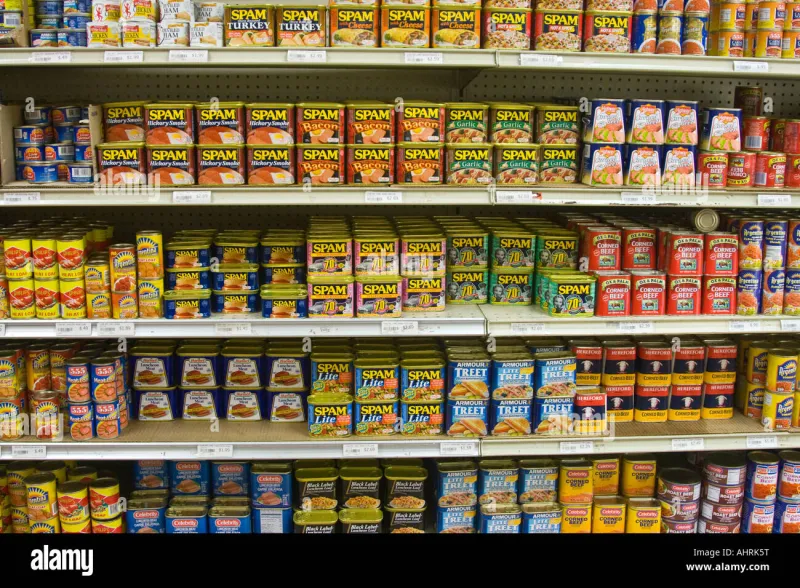
Photo: vintage SPAM canned meat on grocery store shelf retro, via c8.alamy.com
Every day, roughly 45 billion spam emails are sent across the internet. Security companies fight it. Filters catch billions of messages before they land. Entire careers exist around stopping it. And the word used to describe all of it — the technical term, the legal term, the word written into federal legislation — comes from a sketch performed by a British comedy troupe in 1970 about a diner that couldn't stop serving canned meat.
This is that story.
First, the Meat
In 1937, a Hormel Foods executive named Jay Hormel was trying to solve a problem. Hormel had developed a way to sell pre-cooked, shelf-stable pork shoulder in a can — a product that required no refrigeration and had a long shelf life. The challenge was that nobody wanted to buy it, largely because nobody could figure out what to call it.
A naming contest was held at a New Year's Eve party. The winning entry, submitted by a Hormel employee named Kenneth Daigneau (who happened to be the brother of a company vice president, a detail that has never stopped being slightly suspicious), was SPAM. The name was almost certainly a contraction of "spiced ham," though Hormel has always been cagey about confirming this.
For a few years, SPAM struggled. Then World War II arrived.
With meat rationing limiting what civilians and military personnel could access, SPAM became one of the only widely available protein sources in both the United States and Allied countries. The U.S. military shipped approximately 150 million pounds of it to troops and Allied nations during the war. Nikita Khrushchev later credited SPAM with helping feed the Soviet army. Margaret Thatcher called it a "wartime delicacy," though the quotation marks around "delicacy" feel entirely appropriate.
By the time the war ended, SPAM had achieved something remarkable: it was everywhere, it was affordable, it was recognizable — and a significant portion of the population was absolutely sick of it. The product had been so aggressively omnipresent during rationing that "SPAM" had quietly begun to take on connotations of unwanted repetition. Something you couldn't escape. Something that kept showing up whether you wanted it or not.
Enter the comedians.
The Sketch That Changed Everything
In 1970, Monty Python's Flying Circus aired an episode featuring a sketch set in a greasy spoon diner. A couple sits down to order breakfast. The waitress recites the menu, and every single item on it contains SPAM. Spam and eggs. Spam spam and eggs. Spam spam spam spam baked beans and spam. A group of Vikings at a nearby table keeps breaking into a chorus of "SPAM, SPAM, SPAM, SPAM" — louder and louder, drowning out any attempt at normal conversation.
The joke was simple: SPAM was so inescapable, so repetitive, so impossible to avoid, that it had become a kind of sonic wallpaper. The sketch ran for several minutes, the word "spam" appearing over 130 times.
It was funny. It was also, completely accidentally, a perfect metaphor waiting to happen.
The Internet Picks Up the Reference
Fast-forward to the early days of online communities. In the 1980s and early 1990s, as bulletin board systems, Usenet groups, and early chat platforms began to develop, users started encountering a new and deeply annoying phenomenon: people flooding conversations with repetitive, unwanted messages. The same commercial pitch posted to dozens of unrelated forums. The same text repeated hundreds of times in a chat room to disrupt discussion. Content that overwhelmed the signal with noise.
Somewhere in those early online communities — the exact origin is disputed, but strong evidence points to multi-user dungeon (MUD) gaming communities and early Usenet groups in the late 1980s — someone made the connection to the Monty Python sketch. The behavior of flooding a space with repetitive, unwanted content was the SPAM sketch. It was the Vikings drowning everything out. It was the menu that wouldn't stop.
The term caught on with remarkable speed. By the early 1990s, "spam" was in common use across internet communities to describe any unsolicited, repetitive, or disruptive mass posting. When commercial email marketers began blasting millions of addresses with unsolicited advertisements — most famously a 1994 incident in which two immigration lawyers named Canter and Siegel sent mass advertisements to Usenet groups, widely cited as one of the first large-scale commercial spam campaigns — the word was already there, ready and waiting.
From Slang to Federal Law
The term moved fast. By the mid-1990s, "spam" was standard vocabulary for any unsolicited bulk communication. Email providers began building filters. Tech journalists used the word in mainstream publications. And in 2003, the U.S. Congress passed the CAN-SPAM Act — the Controlling the Assault of Non-Solicited Pornography And Marketing Act — embedding the word permanently into federal law.
Hormel, for its part, has had a complicated relationship with this development. The company has generally tried to maintain a distinction between SPAM (the beloved/despised canned meat, always capitalized) and spam (the digital scourge, lowercase). They've asked the internet, politely, to keep the capitalization consistent. The internet has largely ignored this request.
The brand has leaned into the absurdity with varying degrees of success. There's a SPAM Museum in Austin, Minnesota. There are SPAM-themed cookbooks. The product found renewed cultural relevance in Hawaii, where it remains genuinely beloved and appears on McDonald's menus. Hormel has made peace with the situation, more or less.
The Accidental Metaphor That Won
What makes this story worth telling is how perfectly the chain of accidents lines up. A canned meat product became overexposed during wartime rationing. That overexposure made it a cultural symbol of unwanted repetition. A comedy group turned that symbol into a sketch. Early internet users recognized the sketch as a perfect description of bad online behavior. That description became universal slang. That slang became law.
Nobody planned any of it. Jay Hormel wasn't trying to name digital junk mail. The Monty Python writers weren't building a metaphor for the internet, which didn't yet exist in any meaningful form. The early MUD players who started using the term weren't thinking about federal legislation.
And yet here we are. Every time your email filter quietly moves a message to the spam folder, it's completing a chain of events that started with a New Year's Eve naming contest in 1937 and passed through a fictional Viking-filled diner in 1970.
The meat that nobody wanted to eat accidentally named the mail that nobody wants to read. As origin stories go, it's hard to beat.