The Job Interview Was Broken Before You Ever Walked In the Door
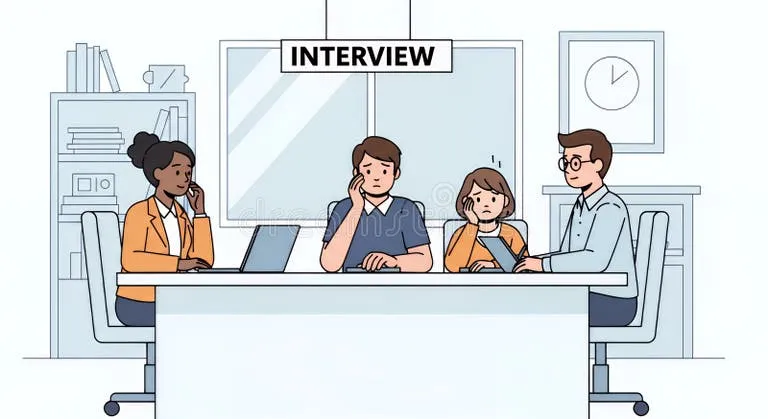
Photo: nervous job interview candidate sitting across desk office, via thumbs.dreamstime.com
You've probably prepared for a job interview at some point. You rehearsed your answers. You researched the company. You picked an outfit, arrived five minutes early, and sat across a desk from a stranger who asked you to describe your greatest weakness — as if there's a single human being alive who answers that question honestly.
The whole thing feels slightly absurd, and that's because it is. The modern job interview, in its standard form, is one of the least effective tools ever developed for evaluating human capability. And it didn't emerge from decades of hiring research. It was borrowed — almost wholesale — from a branch of experimental psychology that was already falling apart by the time corporations adopted it.
The Problem Started in a Psychology Lab
In the years following World War I, the United States military faced an enormous logistical challenge: sorting hundreds of thousands of recruits into appropriate roles as quickly as possible. They turned to psychologists, who were eager to prove that their discipline could solve real-world problems at scale.
What emerged was a suite of personality and aptitude assessments designed to evaluate individuals quickly and rank them according to perceived capability. The underlying assumption — that trained observers could reliably detect stable personality traits through structured interaction — became the intellectual foundation for what would eventually become the job interview.
The problem was that this assumption was shakier than anyone wanted to admit. Even in the 1920s, researchers were noticing that interviewers assessing the same candidate reached wildly different conclusions. The "halo effect" — where one positive impression colored every subsequent judgment — was documented early and ignored widely. The data was inconvenient, so it got filed away while the practice spread.
How Corporations Picked It Up
By the 1930s and 1940s, American corporations were growing fast and hiring at scale. Personnel management was becoming a profession, and the structured interview — a set of predetermined questions asked in a consistent sequence — was marketed to HR departments as a scientific approach to hiring. It had the right vocabulary: assessment, evaluation, trait identification. It sounded rigorous.
What it actually was, in most cases, was a formalized version of something humans had always done: making snap judgments about strangers and then constructing a rationale afterward. The structure gave the process an appearance of objectivity without actually providing it. Studies conducted as early as the 1940s found that most interviewers made up their minds about a candidate within the first four minutes of conversation — and spent the rest of the interview confirming that initial impression.
None of this stopped the interview from spreading. By the postwar economic boom, the sit-down interview was standard practice across American industry. It had become the default not because it worked but because everyone was doing it and nobody had a better idea they were willing to implement.
The Research That Kept Getting Ignored
Here's where the history gets genuinely strange. The evidence against the predictive validity of traditional job interviews has been accumulating for decades — and it has been largely ignored by the people making hiring decisions.
A landmark study published in the 1970s found that unstructured interviews — the conversational, get-to-know-you format that most people experience — had almost no correlation with actual job performance. A more comprehensive analysis in the 1990s confirmed this, finding that structured interviews with standardized questions performed better, but still explained only a modest fraction of the variance in how well someone actually did their job.
Work samples, cognitive ability tests, and peer assessments consistently outperformed the traditional interview in predictive accuracy. The research wasn't hidden. It was published in mainstream psychology and management journals and covered in business schools. HR professionals read it. And then most of them went back to asking candidates where they see themselves in five years.
Why the Format Refuses to Die
The persistence of the broken job interview is one of the more interesting puzzles in American workplace culture. Part of the answer is legal: structured interviews provide documentation that protects companies from discrimination claims, regardless of whether they actually identify the best candidate.
Part of it is institutional inertia. The interview process is embedded in applicant tracking systems, HR training programs, and management expectations. Replacing it with something more predictive — work sample tests, trial periods, structured skills assessments — requires effort, buy-in, and a willingness to admit that the current process is failing.
And part of it is something more human and harder to dislodge: people in hiring positions genuinely believe they can read candidates. The confidence that comes from sitting across a table from someone and forming an impression is difficult to argue against with a regression analysis. The feeling of assessment is compelling even when the assessment isn't working.
There's also a gatekeeping dimension that rarely gets discussed openly. The interview process, in its current form, tends to reward candidates who are good at interviews — people who are comfortable performing under social pressure, who can articulate themselves fluently, who read the room well. These are real skills, but they are not always the skills the job requires. A brilliant engineer who struggles with small talk will consistently lose to a mediocre engineer who interviews beautifully.
Sitting in the Chair Anyway
Some companies have started experimenting with alternatives. Blind auditions, structured work samples, asynchronous video assessments, and skills-based hiring platforms have all gained ground in recent years — particularly in tech, where the gap between interview performance and actual output is most visible and most expensive.
But for most of the American workforce, the ritual persists. You still sit in the uncomfortable chair. You still get asked about your greatest weakness. You still try to project confidence and competence and cultural fit to a stranger who made up their mind about you before you finished your first sentence.
The job interview was never designed to find the best person for the job. It was designed to make the hiring manager feel like they did.